My ebook: Journeys with the caterpillar

My ebook
"
Journeys with the caterpillar: Travelling through the islands of Flores
and Sumba, Indonesia
" is available at
this link


Tuesday, July 22, 2014

The highs and lows of Banjarmasin


Perhaps Banjarmasin is an amphibian. On land, I found this South Kalimantan town like any other Indonesian town, with streaming motorcycles, markets overflowing with stuffed toys, and thousands of Aneka Gorengan (Deep fried snacks) carts continuing their millennial race. But once I ventured into one of the town’s hundreds of canals, Banjarmasin revealed its true character.
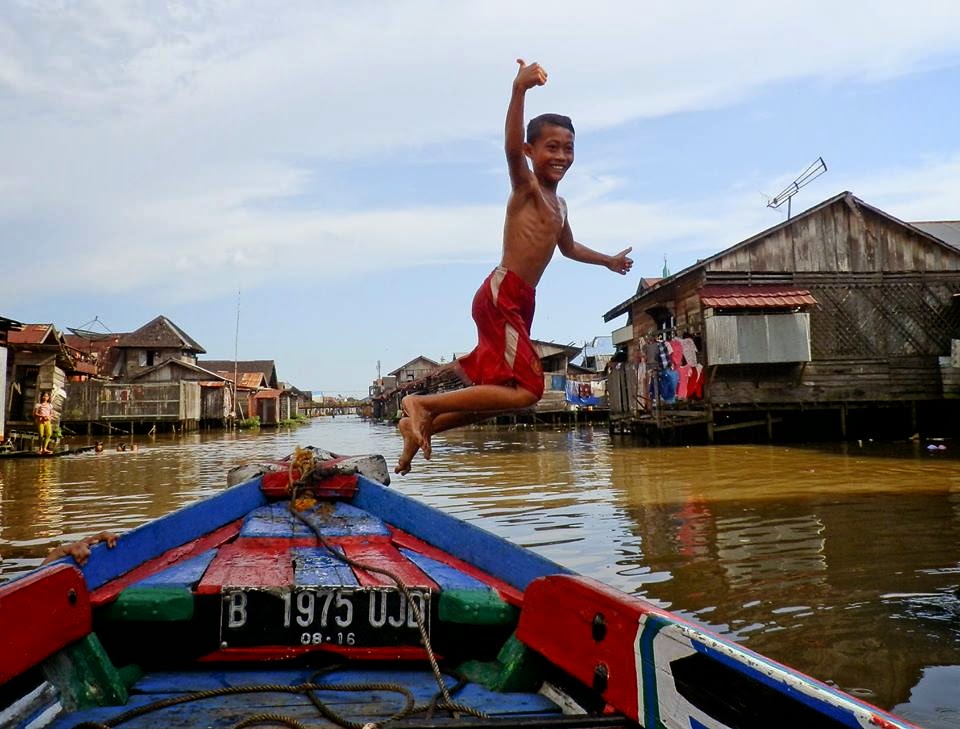
When the engines of my small boat began humming, it was like Basho’s ‘frog jumping into an ancient pond’ moment. “Foreigner, foreigner,” a child screamed at the top of her voice. And this message got relayed from one house’s backyard to the next like wildfire. What I had planned to be a one hour for fifty-thousand rupiah contract with my boatman turned into the greatest egotistical trip of my life. For never had I imagined I had such great capacity to bring happiness to others. The residents of the canal-side houses came out in hordes; bare-naked children, bent-backed grannies, cool-vibe oozing soccer teens, toned young males made of copper and beaming pregnant mothers. At my very sight, the children became ecstatic. The boys jumped from their backyards creating waves that folded the otherwise perfect reflection of the houses on the canals. Kids dropped all around me, splashing water that drenched me wet. They swam as fast as they could to my boat, hoping to touch me just once or even better, give a high-five. The stronger boys managed to climb on to my boat and not knowing what to do afterwards, just gave me a smile and fell back into the water. The younger ones screamed out, shaking their head, closing their eyes in utter delight. The girls and the older people folded hands and greeted me with big smiles. There was no doubt! What a wonderful person I am! I didn’t know how to react. It was a sudden attack of innocence on my senses. I wanted to join in the ecstasy, somersault and dive in the murky water, and then scream around with the jovial children. But I had a one hour fifty thousand rupiah contract. So I just waved and waved. “He waved at me, he waved at me!” the neighbourhood was in raptures. I almost felt like I could make the world a better place.

Once things calmed down, I could finally marvel at the endless stream of houses sitting at the banks canals, leisurely hanging their scrawny wooden legs in the water. Houses, mosques, madrasas, grocery shops, furniture stalls, all built with patches of wood, the same colour as the canals, nailed to each other. Some of the houses had lost their footing and were slowly merging with the canals, looking like old men slowly crouching for a hot spring bath. Colourful coffins waited patiently in the coffin workshops along the canal. Canals, canals, more canals; some wide as a soccer field pretending to be a river, some narrow as a log of wood; they connected here and there creating a maze, going about quietly with the business of moving all the muddy water from the washing of the Meratus Mountains; closely watched over by roaming patrols of hyacinths and water lilies.

Here, mornings began with the boatmen and boatwomen waking up the owners of the gasoline stalls by the canals; first by calling their name, then clapping, and then a friendly shove with the oars. Soon, Gauguin’s women came out from the backyards of each house and lather their whole bodies and mouths sitting on the small jetties built from their house, for the women of Banjarmasin love to shower and brush their teeth at the same time. The elderly man came out too, and hundreds of eager fish would splash out begging them for food in the fisheries built on the canals, because it was breakfast time in Banjarmasin.

As the day progressed, the canals became the highways moving people in all direction, tiny heads in white hijab going to school, ducking every time their boat passes under a bridge. An endless flow of motorcycles with their helmets keep running on these bridges; from the boats below, they look like chess pawns on roller blades. The canal fairies of Banjarmasin, the colourful old women selling bananas, guavas, rice and other supplies on canoes, rowed from door to door looking for custom. Throughout the day, elderly women sat facing the canoe holding a fishing rod. And also throughout the day, a thousand and one buckets tied with long strings, built to fetch water from the canals, swung from each backyard like a pendulum, keeping time in the canals of Banjarmasin.

During noon, Banjarmasin is an oppressive piece of earth as the sun turns into a baker. I rushed indoors, inside my small room in the Sariah-compliant hotel, sitting, dozing, moist from the sweat, my arms feeling like enormous concrete blocks. Hour after hour of doing nothing, not a single movement in the dark windowless room, trying to think but soon losing every chain of thought. I was turning into a statue with a drooping head. I was decomposing in Banjarmasin. I was scared. I needed to make a move before the flies moved in from under the doorsil. But I was in a state of trance. My elephant limbs refused to budge. I recalled the high-fives. The children must be waiting for me in the canals, their heads bobbing in and out of the murky water. I had to go. I had to stay alive. I concentrated. My head rose up slowly. The fingers moved. In one huge effort, I left my damp grave and soon I was on a boat in the canals of Banjarmasin.

After another evening of boosting my ego I rushed back to my hotel to retire early for next day, I had an appointment to keep with my boatman at five in the morning. On my way, I realized that Banjarmasin had changed its streets. Jamu, jamu, jamu; traditional male-power drinks; had lined up neatly along an endless chain of small tables that had sprung up from nowhere. Where had all the shops that I had seen during the day eloped? Jamu, jamu, jamu; this was serious business and vendors were indeed looking dead serious. They set up small stools in front of their table-stalls because at nights, Banjarmasin becomes an enormous winding serpent of Jamu bars where patrons swarm in looking grim, focused, not exchanging a single word with anyone around, ordering a Jamu drink with a gesture, then quietly finishing it in small sips, looking down all the time, their mojo building up inside, and then, with burning eyes, hitting the streets of Banjarmasin.
And then I realized, in this archetype conservative town, some windows and doors were lighting up and calling out to these Jamu filled men; one of such love hotels right in front of my Sariah hotel.    That night, I dreamt that I was frolicking about among thousands of half-opened durians, all a bright orange that I had only seen in Banjarmasin.
5 AM, and it was very dark, but the motorcycles were still keeping the streets awake in Banjarmasin. I walked along the banks of one the canals to meet my boatman. There were a few people slumbering about; dark silhouettes, a woman in sleepwear, certainly insane, holding up one arm to heaven; a man walking in helical steps, a stick in his hand; another man wearing a hat, peeing in bits here and there, marking territory. I tried to disappear into the night as well as I could, moving like only a black cat could. And then I came across a young woman who was perhaps wearing a tight jacket and jeans. She had obviously been standing for long as she kept shifting weight from one leg to another. She whistled at me and said, “Come on, young man, let’s play.” I hurried my pace and my heart caught up. What harm could she do to me? But I was petrified. She didn’t walk after me but kept talking, “Come on, darling.” The mosques across the canal began speaking out too and their synchronized muezzin calls were drowning out her voice. I had almost escaped her, when she called out, “It’s cheap!” The muezzin calls wouldn’t stop. “Help me, I am hungry,” she screamed. That moment my hurt sunk and I wept along the canals of Banjarmasin. 


Thursday, May 29, 2014

Please support our crowdfunding campaign for photo exhibition on Morocco

https://www.crowdonomic.com/project/1504-photography-exhibition-on-morocco


Dear friends, we need your support!

Our next photography exhibition is coming ( "Flowing with the meandering medina", on cultures and architectures in old cities in Morocco, 3-18 July).

We are now trying hard to generate funds through crowdfunding to print the photographs in large format and organize an opening reception. We are offering exciting rewards in return.

Need your help to get this started. Please please visit our campaign page and share it among your friends. Every contribution will help us a lot to kick-start our campaign.

Link below
https://www.crowdonomic.com/project/1504-photography-exhibition-on-morocco

Wednesday, May 14, 2014

Fishing the Bowels of the Earth – Artisanal Diamond Mining in South Kalimantan, Indonesia


As my motorcycle entered the diamond mines at Pumpung, a village near Cempaka in South Kalimantan, I was greeted by the buzz of several throbbing hurts, makeshift water pumps scattered around a vast green flatland interspersed with tiny brown hillocks. Each hillock had a bamboo stairway to heaven placed in front of them.  The trail to these was flooded, and I walked like a drunkard along the edges, trying to keep my feet dry and clean. Soon I spotted the first pit, where the earth had hidden its treasures but failed to keep the secret.

Four men stood along the slopes of the pit, digging for fortune. The earth, a swampland, constantly oozed water into these pits to annoy these men, like a child not wanting to share her toys. The pumps worked for the men to suck out this water while the sun worked for the earth to scorch the men. Again and again, the men would slip and slide down the mud. But they climbed back, fully layered in mud, almost unrecognizable from the pit, and then again gave the pit a few blows with their shovel before sliding down. I imagined the fancy jewellery stores with perfect air-conditioning in Singapore and Jakarta, with sharp-suited sales girls guiding our vision with warm spotlights on dark velvet. This world couldn’t have been further from that.

As soon as the miners saw me, they found an excuse to take a break from this contest and struggled up the pit to give me high-fives. Then immediately, they apologized realizing that their hands were full of mud. “Look what we found today!” Anang, a man in his thirties with a chiselled face and weather-beaten skin, showed me two rocks with black innards, “It’s not that most precious stone, but these will get us ten thousand rupiah.” That’s a little less than a dollar. Mostafa, a miner in his early twenties with baby cheeks, was the most excited, “Come take my picture with these rocks!” he poses, “Hey, you!” He shouts to the two men working the pump, “Pose for him.”

Anang and Mostafa showed me around, “We dig out the mud and then mix it with more water and then put it in these machines,” The machines, which I had taken to be the stairway to heaven, were for sluicing. “Then the mineral bearing rocks separate out from the mud after which we have to inspect these rocks manually.” Three old men were shovelling up the mud to the mouth of the sluicing machines. They were panting in the heat, resting after every four or five attempts. “We take turns to do this,” said Anang, “All of us are from the same village. I have been doing this for twelve years. My father has been at it for thirty years.”

Many such mines are scattered around south Kalimantan. The miners exhaust one pit and then move further to dig a new one. Diamond mining here is over a hundred and fifty years old practice though some date this to over four hundred years. Apart from Diamond, the pits give out other minerals such as topaz, emerald, amethyst and gold. In 1965, a 166.85 carat diamond named Trisakti was found in Pumpung. And in 2008, a 200 carat diamond named Puteri Malu was found nearby. However, it is unusual to find anything over 5 carats from these mines. Anang says, “It’s not just the size. Most of the diamonds have defects and sell for much less. But we just need one big one,” he makes a round hole with his fingers, “Just once, this big!”
 
Anywhere in the world, artisanal mining is as much about hard work as it is about superstitions. At Pumpung, one shouldn't ever say the word intan (diamond) in the vicinity of the pits; else he will not hit diamond for years; just like Garimpos in Mato Grasso in Brazil believe that one is doomed if one finds gold instead of diamonds. Mostafa whispers as he giggles, “That man with the hat working at the machine; he doesn’t talk to anyone. He keeps saying some prayers all the time when at work. But he hasn’t got any big diamond yet.”

The Pumpung miners and the Garimpos also deploy similar business models. The proceeds from the sale is divided between the miners, the owners of the machines and the owner of the land. “Whatever we get, our leader goes and sells at Martapura. We keep fifty percent which we share equally among ourselves, the owner of the machine gets fifteen, and the landowner gets the rest. Some miners don’t use machines and just sort with pans.” Conditioned by my grab-it-all urban conditioning, I have the obvious question; what if you don’t tell the others. “Oh no, that is not possible,” says Anang, “Everyone knows everyone here. You cheat once and you will be outcast for life.”  I recall stories of cheating Garimpos desperately begging anyone to buy all their diamonds in return for a single bowl of Feijoada (bean stew) because not a single buyer would buy from them.

The diamonds and other gems collected from Pumpung are processed in small workshops in the neighbouring town of Martapura. At Martapura, there are many small stores selling the jewels. Visitors come from all over Indonesia to these jewellery stores in Martapura. Again these are not fancy stores; just countless beads hanging from walls and dooframes and the more precious jewels housed inside glasstop wooden cupboards. Some individual sellers just walk around from one prospect to another, taking out his handkerchief to show his collection of gems.

It is time for lunch and the miners gather at a makeshift warung which has been set up by one of the villagers near the pit. “Each pit has its own warung, if she sees us walk over to the next warung, she will scream louder than these pumps” the man who says prayers takes a break to crack this joke at the warung’s owner and the entire group breaks into laughter. Mostafa says, “Yes, that’s another rule for the miners. Even though our house is just a five-minute walk, we have to have lunch at our respective warungs.” Lunch is instant noodles with a glass of tea and afterwards, as the miners relax over a smoke, I head on to the neighbouring pits.

Again, the young men digging the sides are overjoyed and pose for me, asking for photographs, some raising Ronnie James Dio’s famous sign of the horns. The youngest of the lot slides in the walls of the pit and lands on the water below. He then goes completely under the muddy water. His elder brother, Ahmed, walks up to talk to me, “My brother is a water buffalo. He can’t take the heat for long and goes in the water every now and then.” Ahmed is twenty five and has been working at the mine for five years, “I have two daughters already. Both go to school. We get married by the time we are twenty.” Ahmed says that working in the mines is safe but it is tough initially, “When I started here, I used to get fever every few days. The sun was unbearable. But you get used to it.” The miners work from sunrise to sunset and take a day off on Friday.

Diamond mining in South Kalimantan has been through ups and downs; a contest between greater mechanization and the consequent depletion followed by even greater mechanization. And despite so much depending on the hope of that one big find, the miners remain equanimous about their lives. They are driven by natural human spirits; to take risks but also to share risks. They are curious to know about the outside world and relish interacting with outsiders. Pumpung, the home they have built for themselves, is a charming idyll of colourful clothes on washing lines with only the occasional scampering chickens disturbing the peace. And on Fridays, they don their best clothes to go to Martapura to pray at its Grand Mosque and shop and eat with their family at the market.

As I rode back, the women and children shouted goodbyes and I was left with a warm feeling. My hands, muddy from the high-fives, had dried-up. And I had this sudden whim to never wash my hands again.

Tuesday, April 22, 2014

Alun-alun, the happy heart of Malang, Indonesia

The Alun-alun, or town square, is the heart of Malang, a heaving, beating heart. People come in to this heart in thousands and leave it, all pumped up. As they come and enjoy this wonderful public space, they shed all the labels attached to human beings – rich, poor, Muslim, Christian, local, outsider. They come and they smile for they realize that none of them has yet lost their ability to enjoy small things – three quail eggs with chili sauce, a padded heart key chain, and some time spent watching a pigeon-box. 
Built in 1882, the Alun-alun of Malang, like all town squares in Java, served as a space for activities related to religion and public administration in its early years. During the peak of Dutch rule, the action shifted to a different Alun-alun, round instead of square, at the Tugu area surrounding which the buildings of the colonial administration were erected. Post-independence, the original Alun-alun became a space for small-time hawkers. Today, it is a public space, a place for tid-bits, shopping for stuffed toys and some free entertainment. It is the Indonesian version of the famed Jemaa el-Fnaa of Marrakech, without the hustlers.
Built in accordance with traditional Javanese architectural principles, the square has banyan trees for shade at each corner. It faces the Grand Mosque (Masjid Agung), and is surrounded by shopping malls and departmental stores. Even before you enter Alun-alun, the outer edges of the surrounding road, which almost looks like a moat around the square, are lined up with pushcarts selling all the popular Indonesian snacks and drinks.
As you enter the outer fringes of Alun-alun, this battery of pushcarts continues. But now you realize that there are thousands of people in this square. You had come here earlier in the morning. Back then it was a completely different atmosphere and the square was filled with uniformed cleaners and unformed school children following instructions of their respective Physical Education teachers. But now, it’s a Sunday evening, the most popular time to come to the square. You pause for a moment to soak in the atmosphere. Children are running all around you. Old couples and young lovers are crammed on the benches under the banyan shade. Those without lovers are moving around leisurely in groups, showing off their cool, and checking what the square has to offer today. It is noisy, but it is a happy noise, a noise blended in with lots of laughter.
You start moving towards the centre; the next layer that greets you consists of vendors of stuffed toys who have placed on the floor an extensive collection of smiling Yogi Bears, Spongebob Squarepants, and Angry Birds. In between this layer, you spot a few odd women out; a lady who has come in with a family of inflated penguins, and another lady who is offering a game of putting rings on coke bottles, 10,000 rupiah for ten attempts.
You move on and climb up a few steps on to an elevated platform at the centre of the square. The layer that you see now is made of plastic ponds where children sitting on small stools are fishing with hooks for rubber balls. You are thrilled watching this; the tension in the air is palpable. A baby boy almost manages to pull out a ball only to drop it at the last moment. His parents gasp! Another baby girl starts wailing, she hasn’t had any luck while the kid sitting next to her have been pulling one after another effortlessly. Her parents sigh.
Since the pushcarts can’t move up to this place, the food vendors are selling whatever they could bring on their backs. You start with the fried tahu and eat it with the raw chilies. Ibu Ria, the old lady selling the tahu, tells you, “I have been coming here for forty years. I used to have a drinks stall there. Now my son manages that.”  But now the chili starts to bite you and you grab a sweet steamed pancake from the guy squatting next. His hands are working gracefully with the pancakes with long metal sticks, almost like a praying mantis. The sugary delight helps you recover and you now go for the boiled sausages and quail eggs and have it with chili paste. Now you need to recover again, so why not go for a healthy option, fruit salad? Oh, but as soon as you finish the fruits, you notice a beautiful bar with inverted glasses decorating its arches. So you should now have some ice-cream with fruits and condensed milk too. You have spent less than two dollars and you have already filled yourself twice over.
You walk back towards the centre; the fountain in the middle has started spouting. You hear some soft drumming. What is it? Oh, a masked monkey (topeng monyet) show is on. The monkey is dressed like an action hero, in denim trousers and jacket, riding a toy motorcycle, looking for an adventure. His master is aware of the recent banning of topeng monyets in Jakarta and while singing his toothless hypnotic melody, keeps an eye on the audience if someone is taking photographs.
You keep walking along the podium and you hear children’s screams coming now and then from one corner. What’s happening? The children are squatting around a man who is selling live hermit crabs on whose shells a range of human expressions, from shock to dumb delight, have been painted. The children are picking up the hermit crabs with their tiny hands, and when they notice the crab’s legs scampering in the air, they scream and drop the crabs back into the tray. John, the young seller, smiles, “My crabs are used to it.”
You hear more intense drumming. A young man has just arrived. He has made an entire drum kit out of plastic buckets, stacking them up to create a range of sounds. He is trying all sorts of tricks with his drum-sticks. He throws them in the air but fails to catch them. But the audience, mostly mothers with their boys, don’t seem to mind. It’s free entertainment after all. One mother sends her boy to get the sticks back to your passionate drummer every time he drops them.
Suddenly, it begins to rain. There is a scramble. The man with the hermit crabs runs, covering his tray full of crabs like a baby. The man who sold you the ice-cream comes running to you with his trolley, “Go inside one of the shopping malls. Pretend to buy something and then come back after the rain stops. That’s what those shops are for,” he giggles. You join the crowd. Everyone is now pretending to buy something in the mall.
The rain stops soon. Everyone comes back to the square. The old couples have somehow beaten the young lovers for the benches. The monkey sits back on his motorcycle. The sun is setting. The muezzin is calling. The lovers are blending in with the shadows. A disabled child can’t wait to get down from her father’s lap and start fishing for plastic balls. She is the happiest person on earth at this moment. And you decide you will come back again the next day. Such is the charm of Alun-alun.

Monday, April 21, 2014

Sunday night live: Ram fighting (Adu Domba) in West Java, Indonesia


Adu domba (ram fighting) is common in West Java, especially around Garut and Bandung. Villagers spend leisurely Sunday mornings watching these bouts.

For a tourist, finding the place hosting an adu domba is just as much a part of the adventure.
Relying on my sources, I head to Ciwaruga hamlet near Bandung, but the villagers there, excited to see a foreigner, tell me that their village hosted the event the week before and will host it again the week after.

One of the villagers makes a phone call: “My friend is not sure, but you can try your luck at Siliwangi.”

I race to Siliwangi, but it is the same story. However, this time a person who is called on the phone is absolutely certain that the bouts are taking place at Cilimus hamlet.

As soon as I turn away from the concrete expanse of Bandung to the narrow lane of Jl. Cimilus, I can hear the music -- a tell-tale sign that an adu domba is happening.
Soon I can figure out the arena, lined with people watching the contests. Just before this human wall, about 100 rams wait patiently. They have all come dressed up for this occasion, wearing elaborate necklaces. Some have their team names written on the necklaces.

They treat me with utter indifference as I walk past them toward the arena.
Two rams have just been brought in, evenly matched by weight, as is the rule for adu domba.
As soon as they see their opponent, they can’t control themselves.

Rest of the post at The Jakarta Post

Saturday, April 05, 2014

A visit to Batak's medicine woman: My article in Jakarta Post

My wife and I are on the island of Samosir in Lake Toba in North Sumatra and, after three days of cycling around the island, taking the occasional dip in the lake’s waters surrounded by bubblegum-like pink snail eggs and chasing white cranes from the backs of water buffalos, we decide to visit a medicine man.
 
After all, we needed to recover from the exposure to endless love ballads that the local Batak men are so fond of singing at night in the company of other men.
Our search isn’t easy because we have to be specific.
 
Medicine men or women among the Bataks, known as datuks (always male) and gurus, come with three distinct specializations: healing, black magic and communicating with the divine.
The healing ones deal with ailments; the ones for black magic turn to rituals to inflict harm on someone or to win someone’s love, and the ones communicating with the divine deal with interpreting the wishes of gods and ancestors, and also deal in astrology for recommending auspicious dates.
 
So, whenever we asked for a guru, snap came back the question: “Which one do you want?”
We decided that we would rather deal with the healing specialist.......
 

Tuesday, April 01, 2014

A tale of two cities: Ansan and Itaewon – migrant towns in Seoul, Korea

One is known as the ‘Western Town’; the other is being branded as the ‘Multicultural City’, as is typical of Korea, a country a little short of tourist attractions. One is the favourite residential area for the expats, the high-flying foreigners, and young Korean couples looking for a quick western fix. The other is not anyone’s favourite, but the residential area for a big number of migrant labourers who work at the several factories located in the area.
____________________________________________________________________________
Approaching Ansan
 I take the 1 hour long subway from Seoul Station to Ansan, the ‘Multicultural City’. As soon as I get out of the subway station, I see three Pakistani men posing at various spots and taking pictures of one another. Some Christian groups have set up small booths where they are blaring pitches in Korean to attract converts. I go through the underground passage where vegetable sellers have spread out their uprooted gardens. Three Indian families are shopping together; “Do you have any onion?” they ask the Korean ladies who understands them.


Ansna- playing Jianzi
Ansan Streets
Ansan streets
 

Ansan streets
The heat of the action is at Wongok-Dong, nicknamed ‘the borderless village’, where most of the migrants gather. Along a narrow lane running parallel to Bubu-ro street, all the shops are catering to them. Shop-front windows are filled with stickers in English, Vietnamese, Chinese, Russian, Thai, and Bengali. They are selling packets of Sichuan chili, curry powder, sambal paste, and phone cards, lots of phone cards, best rates, cheapest rates, maximum talk time. I see Money Transfer, lots of Money Transfer. Sound boxes outside try to talk to me in Mandarin. On the pavement, some of the wares have spilled over - plastic piggy-banks, oversized jackets, cheap shoes, and a solitary dog placed on an Aluminum tray on a bench, neatly skinned and cut, its head still intact. Nearby, live Asian Carp and catfish are being sold in foam baskets.


Ansan Shopfronts
People in big numbers are slowly moving along this lane, being branded by the city government as ‘Multicultural food street’. Everyone is speaking in Mandarin. After all, rather than being a global village, Wongok-Dong in Ansan is more of a Chinese village. The highlights here are the two big Jiaozi or dumpling stalls whose softly aromatic vapours have set the mood. I approach one to ask for six dumplings and she handles me the whole steaming tray to take inside and find my own way to chopsticks, soya sauce and a plate.

Migrant Comm. Svc. Centre
I meet Ms Jungan Park from the Migrant Community Service Centre, a unique attempt by the Ansan government to assimilate foreign migrants. She provides me with all the statistics. In this town of over 761,000 residents, around 58,100 are foreigners constituting 7.6% of the population as opposed to the national average of 2.2%. People from 78 countries are present in Ansan but more than 70% of the migrants are Chinese of Korean descent. The other big groups are Uzbeks, Vietnamese, Indonesians, Russians, Filipinos, Nepali, Thai and Sri Lankans. Ms Park explains, “Korea has long being a homogenous society. So the activities of our centre are needed to make them accept foreigners whom we need for the 3D jobs – Dirty, Dangerous and Demeaning. We organize sports and cultural events for the migrants which the Koreans are also encouraged to join. Among many other things, we also provide counselling services in multiple languages, organize language classes, and run a shelter for migrant women who have run away from abusive husbands.”
 
Chinese men playing chess

Dumpling Stall (Chinese)
I walk around the small town. A group of young Christians are making last minute preparations for today’s campaign. They are all wearing orange t-shirts. Soon, they branch out handing out pamphlets to anyone looking like a foreigner. Elderly Chinese men have formed groups of four and are playing chess or cards. Many elderlies have gathered at the small town-square. A town official is making a speech. Some programs to celebrate multiculturalism will follow soon as costumed performers wait beside the podium. I come across two Nepali men listening attentively to the official. “Do you understand Korean?” I ask. “No, we don’t,” they smile, “We are just killing time. There is nothing better to do around here.” Nearby, a bunch of four middle-aged Chinese men and women are playing a game of Jianzi that was competing with the official event for crowds. A fat man was approaching everyone passing by to pitch a packet of ginseng.

Ansan streets
I meet a group of ten Bangladeshis on their way to the Seoul Mosque. They are in good spirits and are facing the usual challenge of travelling in a group, getting the entire flock to think alike at the same time. I catch Habibur, who had been positioned on standby till they could sort out matters. After the typical questions about where I am from and where in Bangladesh my parents came from, he asks me the usual questions all migrant workers ask, “Are you looking for a job here? I could get you in touch with someone.” After I explain that I am not, he switches track, “How easy is it to get in to Singapore? I have been here for eight years. They won’t let me stay here anymore after this term ends. Can you get me a job in your company?” 
Ansan Streets

Arif, who had been left behind a bit, catches up with me. “Brother, are you a Muslim?” he asks, “Not a problem. We are all brothers sharing the same language,” his voice turns extremely civil. “Life is not too bad here for us. But sometimes, the managers and other Korean workers shout at us. I think they say bad things. But today is a holiday and we are going to the Seoul Mosque for the first time.” Other men from the group gather around me and we again share details about our origins. “Stay well, brother,” they bid me farewell.
___________________________________________________________________________
 
Itaewon Cool
My next stop is Itaewon, the ‘Western City’. Big solid blocks of high-end restaurants greet me with tables covered in long white sheets. Shop names are all in English and of course there are the familiar McDonalds, KFC, Burger King, etc. Some shop-fronts imitate Victorian or Art Deco facades. Young Korean couples are walking the cobbled roads, posing every minute for selfies, making the world stop or walk around them. In the cold, a young Korean man wearing just a t-shirt, an elaborate hairdo and a smoke, is moving around from one door to another without purpose. Outside a convenience store, four British residents have set up two tables to eat their warmed up noodles and are talking loudly, “It’s f**ing expensive here,” says one. “Yeah, especially for housing,” says another. “Yeah, that’s a f**ing problem, you can’t save f**ing anything here.” Their complaints fade as I come down this cobbled street into the main lane of the Itaewon market, a favorite tourist haunt.
Itaewon chic
Men wearing American army uniforms are looking for a bargain. English teachers, an abundant species in Korea, are walking in both directions. Korean men from the tailor shops which form the backdrop of these streets are asking me again and again, “Do you want a shirt made for you? A pant may be?” They lose memory like goldfish and the same people ask me the same questions again when I take the walk back. A group of Chinese tourists guided by a yellow flag have just risen from earth, from the subway station. This is their hopping stop and they dutifully go through each of the small cubicle shops placed along the pavement, Korean wallpaper paintings on their walls, all selling the same items: socks, caps, souvenirs, and the same witty t-shirts that you get anywhere in the world. Whistle, the flag stops and turns around, the Chinese tourists go back to the underground world in unison.
Itaewon style
I catch up with Roy (name changed), an English teacher from Sacramento who has been in Korea for over ten years. “I didn’t plan to stay so long. But back home, you can’t make a living teaching English after you have paid the hundred taxes. And in California, they keep trying to bring in laws to turn teachers into paupers.” He comes to Itaewon every weekend, “You should come here as a single. There are such great clubs in this area and Korean people are very friendly if you know what I mean.” No problem of assimilation here then. “Not at all,” he laughs, “During the day on weekends, you can join the aunties for treks and during the night their daughters can join you for a bumpy ride.”
But this glitzy world changes suddenly changes as one walks up the hill from Itaewon. There are more Indian restaurants, but they have lost the fortress like appearance of the ones in Itaewon. Back comes the oversized jackets inside and outside the shops. People with distinctly Arab, South Asian and Malay faces are just idling against shop walls. Hijabs on mannequins, Pakistani travel agency, Turkish Kebab dig, Malay restaurant, I can see the minaret of Seoul Mosque already. I meet again the group of Bangladeshis from Ansan. They have taken the pamphlets about Islam from the mosque and distributing it to any occasional Korean who drops by to take some photographs. Outside, an elderly Korean lady is visiting every shop and asking the shop owner in English, “Where are you from?” The shop owner inevitably hesitates and answers, “Korean.” “Don’t say that, you understand! Say what you are, a Pakistani,” enraged, she walks away to the next store. I run for cover. 
Seoul mosque - Itaewon

Hijabs outside Seoul Mosque