My ebook: Journeys with the caterpillar

My ebook
"
Journeys with the caterpillar: Travelling through the islands of Flores
and Sumba, Indonesia
" is available at
this link


Showing posts with label Society. Show all posts

Sunday, February 01, 2015

Where the sea and the city tell each other stories: Makassar


Jalan Nusantara, or Archipelago Road, how aptly named! At Makassar, this road divides the two worlds of stories, the land and the sea. On one side is Makassar port, one of the busiest in Indonesia. On the other is a row of cafes, karaoke bars, hotels and restaurants; shutters down during the day, and at night, barely lit, revealing themselves as brothels. These two worlds meet every night after a long day of anxious waiting when sailors and young ladies, both groups who have arrived from all over the Indonesian archipelago, disappear in the arms of each other.
It is nine in the evening and Jalan Nusantara feels ominous with the constant barrage of monstrous trucks carrying the impenetrable realms of containers. The ladies, with fresh make-up, have just begun to come out from the dark, sitting themselves on a long row of plastic chairs that have now lined Jalan Nusantara. In Indonesia, commercial sex workers are known as Pekerja Seks Komersial or PSKs, a name that seems straight out of Carl Linnaeus’ book. They are now sitting themselves in rehearsed postures of crossing their legs, baring one to catch the light from the streetlamps. Makassar is one of the few cities in the world where, as was common in much of the world before, ports still attract brothels.
I see sailors attempting to make the dangerous crossing of Jalan Nusantara through the plying trucks. From across the road, the women begin whistling and clapping at him. The sailors, in small groups of two or three, are halting, sprinting, halting, dodging and jumping as the women cheer them on. Once on the other side, they have a smile that soon turns shy. The girls call out to them. The sailors walk on for a while, avoiding making eye contact, till a bold female hand holds their hands and pull them in. One woman gets up and grabs the hand of a sailor and pulls him in. Isn’t she a teenager? Her co-workers push the other men in too who don’t resist.
I wonder if the sailors and the PSKs tell each other stories; stories from the sea, of mysterious creatures, countless stars, near-miss accidents, and weeks and months spent away from the comforts of home; and stories from the land, of youth and families left behind, of the range of body odours they have encountered, of the never-sleeping fear of the unknown, or of hopes still alive. 
The PSKs and their agents are calling after me too. But I am not a sailor and my heavily insured life is too sterile, my stories bleached of much of the pains of life. One man, probably the manager, screams and points at the girl sitting next to him, “Stock Baru,” new stock. Where would she be from? PSKs usually work in cities far away from home to hide their identities. Red light areas all over Indonesia are known to run exchange programs for PSKs so that local customers get acquainted with new people.
I keep walking. Suddenly one man opens a door to reveal a dazzling world of lights and women scantily clad, seated in stacks. They look like lifeless mannequins; staring vacantly towards me or are they longing for the door that just opened out! Like a man possessed by a messianic duty, I run from Jalan Nusantara, gasping, my heart as heavy as a container truck.

Saturday, December 13, 2014

My open letter to open letter writers

The culture of writing open letters has taken India by storm. What essentially began as a subculture among unknown IIT graduates (remember those 'Open Letter from an IITian to Shivaji Das'), has now been taken over by celebrities. That is somewhat understandable because Open Letters are highly secure, the recipient can never get the contact details of the sender, so no chance of receiving Tution and Insurance agent fliers. Open Letters also solve the problem of having to know and write down the detailed address of the recipient.

So while the Indian Postal Service still rules the roost with more than 50 million letter deliveries a day, open letters are catching up fast [over 3 million open letters in circulation in India if Google Search is God].

But a stinky reality of this open letter obsession is that if no open letter has been addressed to you, you are a complete nobody. So friends please write me a one. I was kidding earlier about that open letter to me. I am still waiting for one at my mailbox.

Tuesday, July 22, 2014

The highs and lows of Banjarmasin


Perhaps Banjarmasin is an amphibian. On land, I found this South Kalimantan town like any other Indonesian town, with streaming motorcycles, markets overflowing with stuffed toys, and thousands of Aneka Gorengan (Deep fried snacks) carts continuing their millennial race. But once I ventured into one of the town’s hundreds of canals, Banjarmasin revealed its true character.
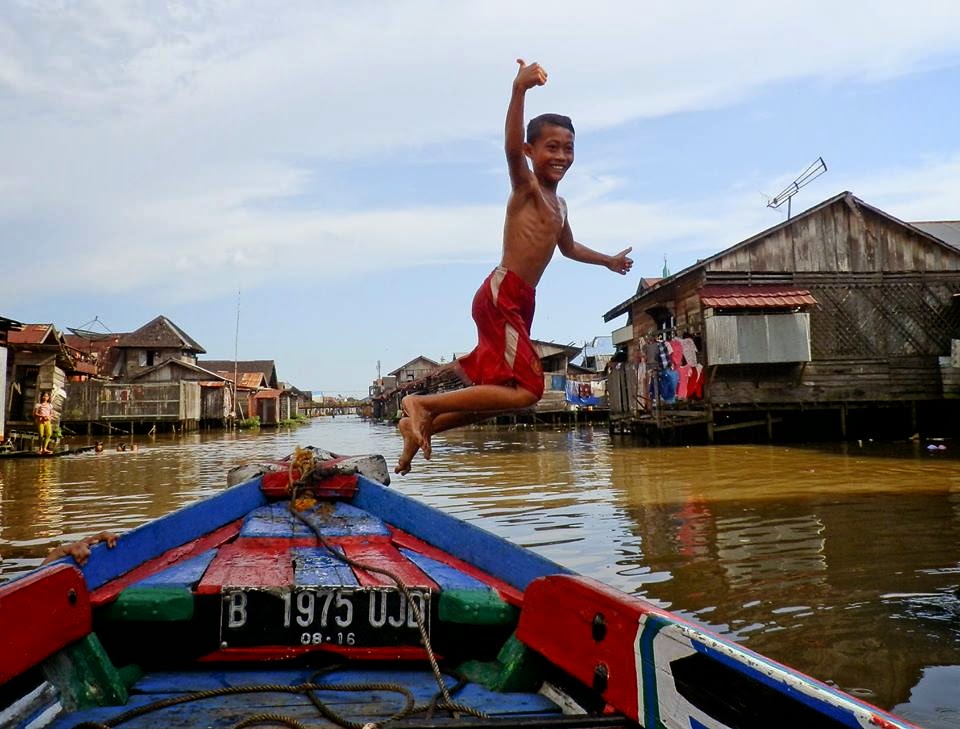
When the engines of my small boat began humming, it was like Basho’s ‘frog jumping into an ancient pond’ moment. “Foreigner, foreigner,” a child screamed at the top of her voice. And this message got relayed from one house’s backyard to the next like wildfire. What I had planned to be a one hour for fifty-thousand rupiah contract with my boatman turned into the greatest egotistical trip of my life. For never had I imagined I had such great capacity to bring happiness to others. The residents of the canal-side houses came out in hordes; bare-naked children, bent-backed grannies, cool-vibe oozing soccer teens, toned young males made of copper and beaming pregnant mothers. At my very sight, the children became ecstatic. The boys jumped from their backyards creating waves that folded the otherwise perfect reflection of the houses on the canals. Kids dropped all around me, splashing water that drenched me wet. They swam as fast as they could to my boat, hoping to touch me just once or even better, give a high-five. The stronger boys managed to climb on to my boat and not knowing what to do afterwards, just gave me a smile and fell back into the water. The younger ones screamed out, shaking their head, closing their eyes in utter delight. The girls and the older people folded hands and greeted me with big smiles. There was no doubt! What a wonderful person I am! I didn’t know how to react. It was a sudden attack of innocence on my senses. I wanted to join in the ecstasy, somersault and dive in the murky water, and then scream around with the jovial children. But I had a one hour fifty thousand rupiah contract. So I just waved and waved. “He waved at me, he waved at me!” the neighbourhood was in raptures. I almost felt like I could make the world a better place.

Once things calmed down, I could finally marvel at the endless stream of houses sitting at the banks canals, leisurely hanging their scrawny wooden legs in the water. Houses, mosques, madrasas, grocery shops, furniture stalls, all built with patches of wood, the same colour as the canals, nailed to each other. Some of the houses had lost their footing and were slowly merging with the canals, looking like old men slowly crouching for a hot spring bath. Colourful coffins waited patiently in the coffin workshops along the canal. Canals, canals, more canals; some wide as a soccer field pretending to be a river, some narrow as a log of wood; they connected here and there creating a maze, going about quietly with the business of moving all the muddy water from the washing of the Meratus Mountains; closely watched over by roaming patrols of hyacinths and water lilies.

Here, mornings began with the boatmen and boatwomen waking up the owners of the gasoline stalls by the canals; first by calling their name, then clapping, and then a friendly shove with the oars. Soon, Gauguin’s women came out from the backyards of each house and lather their whole bodies and mouths sitting on the small jetties built from their house, for the women of Banjarmasin love to shower and brush their teeth at the same time. The elderly man came out too, and hundreds of eager fish would splash out begging them for food in the fisheries built on the canals, because it was breakfast time in Banjarmasin.

As the day progressed, the canals became the highways moving people in all direction, tiny heads in white hijab going to school, ducking every time their boat passes under a bridge. An endless flow of motorcycles with their helmets keep running on these bridges; from the boats below, they look like chess pawns on roller blades. The canal fairies of Banjarmasin, the colourful old women selling bananas, guavas, rice and other supplies on canoes, rowed from door to door looking for custom. Throughout the day, elderly women sat facing the canoe holding a fishing rod. And also throughout the day, a thousand and one buckets tied with long strings, built to fetch water from the canals, swung from each backyard like a pendulum, keeping time in the canals of Banjarmasin.

During noon, Banjarmasin is an oppressive piece of earth as the sun turns into a baker. I rushed indoors, inside my small room in the Sariah-compliant hotel, sitting, dozing, moist from the sweat, my arms feeling like enormous concrete blocks. Hour after hour of doing nothing, not a single movement in the dark windowless room, trying to think but soon losing every chain of thought. I was turning into a statue with a drooping head. I was decomposing in Banjarmasin. I was scared. I needed to make a move before the flies moved in from under the doorsil. But I was in a state of trance. My elephant limbs refused to budge. I recalled the high-fives. The children must be waiting for me in the canals, their heads bobbing in and out of the murky water. I had to go. I had to stay alive. I concentrated. My head rose up slowly. The fingers moved. In one huge effort, I left my damp grave and soon I was on a boat in the canals of Banjarmasin.

After another evening of boosting my ego I rushed back to my hotel to retire early for next day, I had an appointment to keep with my boatman at five in the morning. On my way, I realized that Banjarmasin had changed its streets. Jamu, jamu, jamu; traditional male-power drinks; had lined up neatly along an endless chain of small tables that had sprung up from nowhere. Where had all the shops that I had seen during the day eloped? Jamu, jamu, jamu; this was serious business and vendors were indeed looking dead serious. They set up small stools in front of their table-stalls because at nights, Banjarmasin becomes an enormous winding serpent of Jamu bars where patrons swarm in looking grim, focused, not exchanging a single word with anyone around, ordering a Jamu drink with a gesture, then quietly finishing it in small sips, looking down all the time, their mojo building up inside, and then, with burning eyes, hitting the streets of Banjarmasin.
And then I realized, in this archetype conservative town, some windows and doors were lighting up and calling out to these Jamu filled men; one of such love hotels right in front of my Sariah hotel.    That night, I dreamt that I was frolicking about among thousands of half-opened durians, all a bright orange that I had only seen in Banjarmasin.
5 AM, and it was very dark, but the motorcycles were still keeping the streets awake in Banjarmasin. I walked along the banks of one the canals to meet my boatman. There were a few people slumbering about; dark silhouettes, a woman in sleepwear, certainly insane, holding up one arm to heaven; a man walking in helical steps, a stick in his hand; another man wearing a hat, peeing in bits here and there, marking territory. I tried to disappear into the night as well as I could, moving like only a black cat could. And then I came across a young woman who was perhaps wearing a tight jacket and jeans. She had obviously been standing for long as she kept shifting weight from one leg to another. She whistled at me and said, “Come on, young man, let’s play.” I hurried my pace and my heart caught up. What harm could she do to me? But I was petrified. She didn’t walk after me but kept talking, “Come on, darling.” The mosques across the canal began speaking out too and their synchronized muezzin calls were drowning out her voice. I had almost escaped her, when she called out, “It’s cheap!” The muezzin calls wouldn’t stop. “Help me, I am hungry,” she screamed. That moment my hurt sunk and I wept along the canals of Banjarmasin. 


Wednesday, May 14, 2014

Fishing the Bowels of the Earth – Artisanal Diamond Mining in South Kalimantan, Indonesia


As my motorcycle entered the diamond mines at Pumpung, a village near Cempaka in South Kalimantan, I was greeted by the buzz of several throbbing hurts, makeshift water pumps scattered around a vast green flatland interspersed with tiny brown hillocks. Each hillock had a bamboo stairway to heaven placed in front of them.  The trail to these was flooded, and I walked like a drunkard along the edges, trying to keep my feet dry and clean. Soon I spotted the first pit, where the earth had hidden its treasures but failed to keep the secret.

Four men stood along the slopes of the pit, digging for fortune. The earth, a swampland, constantly oozed water into these pits to annoy these men, like a child not wanting to share her toys. The pumps worked for the men to suck out this water while the sun worked for the earth to scorch the men. Again and again, the men would slip and slide down the mud. But they climbed back, fully layered in mud, almost unrecognizable from the pit, and then again gave the pit a few blows with their shovel before sliding down. I imagined the fancy jewellery stores with perfect air-conditioning in Singapore and Jakarta, with sharp-suited sales girls guiding our vision with warm spotlights on dark velvet. This world couldn’t have been further from that.

As soon as the miners saw me, they found an excuse to take a break from this contest and struggled up the pit to give me high-fives. Then immediately, they apologized realizing that their hands were full of mud. “Look what we found today!” Anang, a man in his thirties with a chiselled face and weather-beaten skin, showed me two rocks with black innards, “It’s not that most precious stone, but these will get us ten thousand rupiah.” That’s a little less than a dollar. Mostafa, a miner in his early twenties with baby cheeks, was the most excited, “Come take my picture with these rocks!” he poses, “Hey, you!” He shouts to the two men working the pump, “Pose for him.”

Anang and Mostafa showed me around, “We dig out the mud and then mix it with more water and then put it in these machines,” The machines, which I had taken to be the stairway to heaven, were for sluicing. “Then the mineral bearing rocks separate out from the mud after which we have to inspect these rocks manually.” Three old men were shovelling up the mud to the mouth of the sluicing machines. They were panting in the heat, resting after every four or five attempts. “We take turns to do this,” said Anang, “All of us are from the same village. I have been doing this for twelve years. My father has been at it for thirty years.”

Many such mines are scattered around south Kalimantan. The miners exhaust one pit and then move further to dig a new one. Diamond mining here is over a hundred and fifty years old practice though some date this to over four hundred years. Apart from Diamond, the pits give out other minerals such as topaz, emerald, amethyst and gold. In 1965, a 166.85 carat diamond named Trisakti was found in Pumpung. And in 2008, a 200 carat diamond named Puteri Malu was found nearby. However, it is unusual to find anything over 5 carats from these mines. Anang says, “It’s not just the size. Most of the diamonds have defects and sell for much less. But we just need one big one,” he makes a round hole with his fingers, “Just once, this big!”
 
Anywhere in the world, artisanal mining is as much about hard work as it is about superstitions. At Pumpung, one shouldn't ever say the word intan (diamond) in the vicinity of the pits; else he will not hit diamond for years; just like Garimpos in Mato Grasso in Brazil believe that one is doomed if one finds gold instead of diamonds. Mostafa whispers as he giggles, “That man with the hat working at the machine; he doesn’t talk to anyone. He keeps saying some prayers all the time when at work. But he hasn’t got any big diamond yet.”

The Pumpung miners and the Garimpos also deploy similar business models. The proceeds from the sale is divided between the miners, the owners of the machines and the owner of the land. “Whatever we get, our leader goes and sells at Martapura. We keep fifty percent which we share equally among ourselves, the owner of the machine gets fifteen, and the landowner gets the rest. Some miners don’t use machines and just sort with pans.” Conditioned by my grab-it-all urban conditioning, I have the obvious question; what if you don’t tell the others. “Oh no, that is not possible,” says Anang, “Everyone knows everyone here. You cheat once and you will be outcast for life.”  I recall stories of cheating Garimpos desperately begging anyone to buy all their diamonds in return for a single bowl of Feijoada (bean stew) because not a single buyer would buy from them.

The diamonds and other gems collected from Pumpung are processed in small workshops in the neighbouring town of Martapura. At Martapura, there are many small stores selling the jewels. Visitors come from all over Indonesia to these jewellery stores in Martapura. Again these are not fancy stores; just countless beads hanging from walls and dooframes and the more precious jewels housed inside glasstop wooden cupboards. Some individual sellers just walk around from one prospect to another, taking out his handkerchief to show his collection of gems.

It is time for lunch and the miners gather at a makeshift warung which has been set up by one of the villagers near the pit. “Each pit has its own warung, if she sees us walk over to the next warung, she will scream louder than these pumps” the man who says prayers takes a break to crack this joke at the warung’s owner and the entire group breaks into laughter. Mostafa says, “Yes, that’s another rule for the miners. Even though our house is just a five-minute walk, we have to have lunch at our respective warungs.” Lunch is instant noodles with a glass of tea and afterwards, as the miners relax over a smoke, I head on to the neighbouring pits.

Again, the young men digging the sides are overjoyed and pose for me, asking for photographs, some raising Ronnie James Dio’s famous sign of the horns. The youngest of the lot slides in the walls of the pit and lands on the water below. He then goes completely under the muddy water. His elder brother, Ahmed, walks up to talk to me, “My brother is a water buffalo. He can’t take the heat for long and goes in the water every now and then.” Ahmed is twenty five and has been working at the mine for five years, “I have two daughters already. Both go to school. We get married by the time we are twenty.” Ahmed says that working in the mines is safe but it is tough initially, “When I started here, I used to get fever every few days. The sun was unbearable. But you get used to it.” The miners work from sunrise to sunset and take a day off on Friday.

Diamond mining in South Kalimantan has been through ups and downs; a contest between greater mechanization and the consequent depletion followed by even greater mechanization. And despite so much depending on the hope of that one big find, the miners remain equanimous about their lives. They are driven by natural human spirits; to take risks but also to share risks. They are curious to know about the outside world and relish interacting with outsiders. Pumpung, the home they have built for themselves, is a charming idyll of colourful clothes on washing lines with only the occasional scampering chickens disturbing the peace. And on Fridays, they don their best clothes to go to Martapura to pray at its Grand Mosque and shop and eat with their family at the market.

As I rode back, the women and children shouted goodbyes and I was left with a warm feeling. My hands, muddy from the high-fives, had dried-up. And I had this sudden whim to never wash my hands again.

Thursday, February 27, 2014

Interview with Michelle Granas; Author of "Zaremba, or Love and the Rule of Law"

Book description: In Warsaw, a shy and high-minded polio victim lives a life of seclusion caring for her odd family until a chance encounter plunges her into the intrigues of dirty politics. Zaremba, a wealthy businessman, is about to be arrested on trumped-up charges and only she can save him. Swept along by events, Cordelia finds her feelings increasingly involved with a stranger for whom she is both rescuer and victim. When Zaremba is implicated in terrorist activities and disappears, Cordelia is painfully uncertain if she has been abandoned and must overcome surveillance, corruption, the media, and mounting humiliations and difficulties to learn the truth.

This is a story about love between a man and woman, but also love of family, country, and justice. Although set in Poland, where the CIA had a black site, it is a story that could happen anywhere, in a world where young democracies struggle against the temptations of covert operations and older democracies sometimes lead them astray.


Shivaji: Tell us something about your background and what inspired you to write this novel

Michelle:
In addition to being a writer, I am also a translator and often work on texts about international law, foreign policy, or sociology. I am American, but have been living with my family in Poland for many years. Some time ago, when Lech Kaczynski was president and his twin brother was prime minister, the government appeared to be extending its power in improper ways. These occurrences joined a worrying trend by America - and the international community - increasingly to ignore international laws and human rights that had previously seemed unassailable (outwardly, at least). It seemed clear to me that smaller countries might follow the lead of more powerful ones, and that given the tentacles of US agencies, 'security' activities could form an excuse to get rid of inconvenient persons or to settle scores. (And the CIA did have black sites in Poland and elsewhere and engaged in kidnapping in European countries). In 2007, events had become worrisome enough that my husband - who loves Poland - had begun to wonder whether we might have to leave the country. The idea for the novel came to me in the autumn of 2007 and I wrote most of the first part without knowing how the elections in that year would play out. (The Kaczynskis' party lost.)     
 

Shivaji: Your book in essence is a cautionary tale about government overreach. In the last few years, we have been hearing more and more such stories: NSA snooping for instance. Should we really be concerned? After all, the message out there is that all this is being done for our own good.

Michelle:
Well, I think of my book primarily as a love story between two rather unusual characters. But it is also about government abuse of power. The point is that when power is unchecked, it will inevitably extend into the lives of innocent people. We know this from history and human psychology. Every totalitarian or authoritarian regime claims to be acting for the good of the people, and for their security from outside threats. These are claims that should instantly ring alarm bells. American and UK governments continually trumpet the dangers of terrorism within their countries, but when the claim is investigated the threat disappears. Consider for instance, the number of Americans killed by terrorists last year: far fewer than were killed by policemen, fewer than were killed by falling furniture, miniscule numbers in comparison with random gun deaths, traffic accidents, or influenza, anyway. The American government knows this, so why is it putting in place enormous mechanisms of control and secrecy to deal with a comparative non-issue?

Yes, we should be very worried by the activities of security agencies, including the NSA. Investigations (by the Senate Intelligence Committee, for instance) have shown that their spying has not contributed to preventing any terrorist acts. However, the possibilities for using private information about citizens to control a population should be obvious and very frightening. How can journalists write their stories, lawyers communicate with their clients, or ordinary people speak to their acquaintances without fear that their words might someday be used against them -- because of their politics, or their preferences, or for no reason at all -- in devastatingly harmful ways? We already know what can happen to journalists who object to American policies. Unless we all speak out and make our objections to surveillance clear, the bar of allowable speech will eventually lower until we are all silenced.


Shivaji: As your novel also shows, getting a hyper-sensitive media to react in one's favour has become very important to win the battle. And the hyper-sensitive media has an addiction for stunts. Is it the only way left to fight for justice?

Michelle:
No. I think one of the very encouraging trends of recent years is the degree to which ordinary citizens have been able to come together to produce change or stop an injustice simply by adding their name to a petition, sending emails, or standing in a square. The internet has made it possible for many more people to become aware of what's happening in the world and to participate in shaping events. But we all have to make our voices heard - if only by making that click of the mouse - for justice, and peace, and a better world. 

 
Shivaji: In many authoritarian countries, we are also seeing how governments act in response to majority opinion. Whether in China, Central Asia, or South East Asia, the government scrupulously tracks the flow of public opinion and reacts accordingly. Whether it is anti-gay legislations in Nigeria, or Sharia law for non-Muslims in Aceh province of Indonesia; what chance do minority rights or individual rights have in such a context? 

Michelle:
The only chance that individual rights have is if all of us who are aware of their importance work to spread this idea to others: If anyone's rights can be violated, it means that yours can be too; the rights that protect one person protect everyone. In short, the security of the majority lies in the security of the minority. The alternative is a society where no one is free and dissenters are severely repressed (as once in Eastern European communist countries) or situations of civil strife and violence (as we are seeing in many parts of the world today). 

 
Shivaji:
The recent events in Ukraine have shifted fault lines. In a way, the context of your novel was also an outcome of a similar shifting of fault lines when Poland was trying to extract itself from the Russian sphere. Poland turned vindictive; digging out deep corners of it's past to vilify individuals. Will Ukraine or other East European countries tread the same path or was it a uniquely Polish inevitability?

Michelle:
I don't think anything is inevitable. Authoritarian practices or regimes can be brought down by non-violent action, and democracies won't stay democracies unless their citizens are vigilant.

Poland teetered for a while toward authoritarian practices, but then righted itself, and is today a healthy democracy, I would say. Hungary embarked on a similar course toward improper state control and is having more trouble. Russia, after the downfall of communism, never attained real democracy. I do not know what will happen in Ukraine; one sympathizes very strongly with the Ukrainians' desire for change, and hopes that in the process the rights and wishes of Ukraine's minorities are not disregarded.